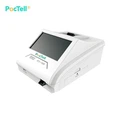
D-Dimer is a specific degradation product produced by activation of the human fibrinolytic system. Its core value lies in assisting in assessing the risk of thrombotic diseases. When conditions such as deep vein thrombosis, pulmonary embolism, and disseminated intravascular coagulation (DIC) occur, the coagulation and fibrinolytic systems become unbalanced, and D-Dimer levels can significantly increase. In clinical practice, it is often used as a key indicator for emergency screening for pulmonary embolism, postoperative monitoring of thrombotic risk, and assessment of coagulation status in critically ill patients. It can quickly narrow the diagnostic scope, avoid missing high-risk thrombotic conditions, and help exclude low-risk individuals, reducing unnecessary further testing (such as CTA and vascular ultrasound). The colloidal gold D-Dimer Rapid Test is an optimal solution for meeting the clinical need for rapid diagnosis and treatment. It requires only a small whole blood/plasma sample and produces results within 15 minutes, making it easy for primary care providers to quickly adopt. The test is highly stable and doesn't require cold chain transportation or specialized laboratory environments, making it suitable for use in emergency rooms, wards, community clinics, and other settings. It seamlessly offsets the time-consuming and equipment-dependent shortcomings of traditional ELISA methods, saving valuable time for early intervention in thrombotic conditions.
Colloidal Gold D-Dimer Rapid Test Interpretation
The colloidal gold D-Dimer Rapid Test typically presents results on a test card. Interpretation focuses on the "control line (C line)" and "test line (T line)":

First, examine the control line (C line): Regardless of the result, a red band must appear on the C line, indicating that the test card is valid and the procedure was performed correctly. If the C line does not appear, the test has failed and a new sample must be taken.
Let's look at the test line (T-line):
Positive result: If the T-line is clearly visible (regardless of color depth), combined with the clinical reference threshold (most colloidal gold methods use 500ng/mL FEU as the cutoff), it indicates an elevated D-dimer level, suggesting a possible risk of thrombosis. Further analysis, combined with the patient's symptoms, signs, and imaging studies (such as CTA and ultrasound), is needed to confirm the diagnosis.
Negative result: If the T-line is absent, the D-dimer level is below the cutoff. This can help rule out conditions such as deep vein thrombosis and pulmonary embolism in patients with low to moderate risk of thrombosis (such as postoperative patients without significant chest pain or dyspnea), thereby reducing over-medicalization.
Note: Interpretation must be completed within a specified timeframe (usually 10-15 minutes). After this time, the line may fade or disappear, rendering the result ineffective. Furthermore, physiologically elevated D-dimer levels may occur in special populations, such as pregnant women, the elderly, and patients with malignant tumors. Comprehensive clinical assessment is necessary, and conclusions should not be drawn based solely on the test results.